A Roadmap for the Future of California’s Expanded Learning Workforce
California’s expanded learning workforce is essential to young people, families, and thriving communities. Every day, youth development professionals nurture belonging, learning, leadership, and well-being. Yet too often, the people who make this work possible are asked to do so without the compensation, career pathways, support, and recognition they deserve.
Driven by a shared belief in the profound impact that fair working conditions and just wages can have on individuals, families, and communities, CalSAC, ExpandLA, and PCY began collaborating in early 2023 and committed to moving beyond ideas and toward collective action. Recognizing the need for a comprehensive approach to addressing system wide challenges, a framework that includes 10 key drivers that are important to building job quality was developed and has guided the collaborative since:
Funding andPolicy: Ensure public resources and policies advance the workforce
Data Collection: Address the lack of an ongoing, comprehensive data collection system to inform policy, funding, and practice.
Recruitment: Identify and uplift new entry points into the workforce and coordinate innovative strategies to build awareness and interest in the field.
Pathways: Clear and accessible avenues that build a steady workforce pipeline, and industry-recognized credentials, and encourage long-term retention.
Training/PD: Flexible, accessible, and relevant education and training aligned with field standards.
Leadership Development: Build and strengthen management and supervisory staff to set the tone, ensure quality and equity, and guide new practitioners.
Organizational Development or Capacity Building: Strengthen the internal operations and culture of organizations to facilitate positive and healthy work environments and an engaged and knowledgeable workforce.
Worker Wellness: Create balanced, sustainable roles that promote wellness as well as address the current strain caused by overwork and secondary trauma.
Strategic Communications: Speak about the field with one, unified voice to build awareness and appreciation for the substantial contributions and impact of the workforce.
Network Building/Convenings: Gather together as a field to track progress, share ideas and resources, and organize collective action.
Through two statewide Summits, deeper and more coordinated partnering on projects, and a half dozen strategy sessions, the collaborative is working toward a future where expanded learning is recognized not as supplemental, but as essential civic infrastructure. We believe that when we invest in the people who nurture young people, workforce dignity, youth success, and community well-being rise together.
Transforming the future of the expanded learning workforce will take all of us.
The future we are working toward
We envision a California where the expanded learning workforce is recognized as a respected, visible, and indispensable profession. Expanded learning is a first-choice career with living wages, comprehensive benefits, clear advancement pathways, and strong public investment.
In this future:
Expanded learning professionals are valued for both lived experience and professional expertise.
Career pathways are aligned across apprenticeships, certificates, community colleges, higher education, and leadership development.
Youth, families, and workforce members help shape policy and governance.
Expanded learning is fully integrated into California’s education and workforce systems.
Every young person has access to high-quality, culturally affirming expanded learning opportunities without barriers or waitlists.
Why change is needed now
Today, the expanded learning workforce faces structural barriers that make it harder for workers, programs, and communities to thrive. These challenges include:
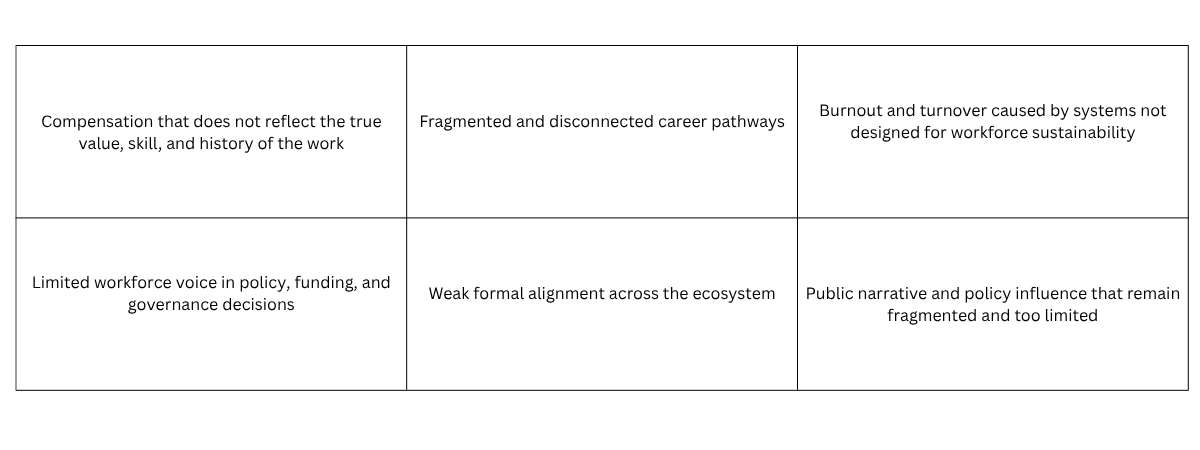
These conditions are rooted in long-standing inequities and underinvestment. They are not the result of individual failure. They are the result of systems that have not fully valued youth development work, community knowledge, or the people most impacted by inequity.
If we want a stronger future for young people, we need a stronger, more just future for the workforce.
What will guide this work
As this roadmap takes shape, four commitments anchor the work:
We build collective power
No single organization, region, or strategy can transform this field alone. Lasting change requires workers, employers, intermediaries, higher education, policymakers, funders, researchers, families, and communities moving toward shared outcomes with shared accountability.
We design for excellence
High-quality expanded learning depends on strong preparation, shared standards, continuous learning, and the supports workers and programs need to thrive. Excellence should be designed into the system, not left to individual sacrifice.
We stand for workforce dignity
Workforce dignity means fair compensation, living wages, comprehensive benefits, worker well-being, and sustainable career pathways. It means refusing to build youth success on underpaid and overworked community members.
We center equity and transform systems
We design from the margins, honor lived experience, and believe those most impacted by inequity must help shape decisions. Equity is not an add-on. It is the foundation for the future we seek to build.
A shared roadmap for change
We see five connected areas of work that can help move the field toward this vision. These are not isolated strategies. They are interconnected parts of a broader ecosystem shift.
1. Build aligned, compensated, and visible career pathways
We need a clearer and more connected pathway into and through the field, from entry-level roles to leadership. This includes apprenticeships, certificates, community colleges, universities, leadership development, and youth-to-work opportunities.
The goal is a pathway system that is visible, aligned, and tied to real advancement, compensation, and long-term career growth.
2. Embed worker wellness and organizational capacity
The field cannot thrive if sustainability depends on burnout and sacrifice. We need systems, funding, supervision, and organizational practices that support worker well-being, strong leadership, and healthy organizations.
The goal is to make wellness, retention, and sustainability structural — not optional.
3. Align policy and public investment with workforce dignity
Public policy and funding should reflect the true cost, value, and historic context of expanded learning work. This includes compensation, benefits, planning time, professional learning, supervision, and workforce supports.
The goal is to embed workforce dignity and economic justice into policy and investment decisions.
4. Shape narrative and build collective identity
Expanded learning should be widely recognized as essential to thriving communities. At the same time, workforce members should be able to see themselves as part of a larger profession and movement.
The goal is to strengthen both public recognition and internal connection across the field.
5. Build integrated backbone infrastructure for the field
We need stronger alignment across the ecosystem so progress does not depend only on informal relationships or disconnected efforts. This includes governance, shared outcomes, collaboration, and accountability across organizations and initiatives.
The goal is to make field alignment more durable, coordinated, and sustained over time.
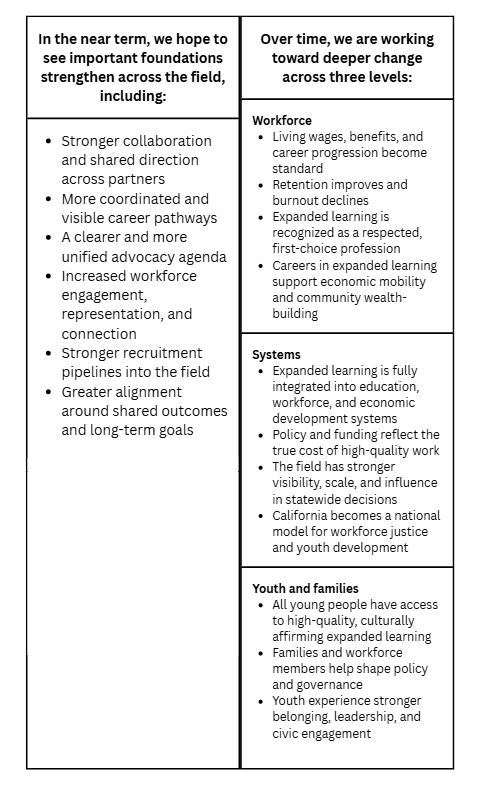
What we hope will begin to shift
Join Us in Shaping the Future
This roadmap envisions a future where California’s expanded learning workforce is valued, supported, and able to thrive.
It is grounded in a simple belief: building a stronger future for young people and communities requires a stronger, more just, and more sustainable future for the workforce.
Transforming the expanded learning workforce will take all of us. We invite you to join us in advancing that future together!
Save the Date: It Takes All of Us: Expanded Learning Workforce Summit #3 is coming to the Bay Area this Nov/Dec 2026!
Get involved!